
Neither CBD nor THC is clearly supported by robust clinical evidence for treating anxiety, but real-world experience suggests CBD may offer symptom relief with fewer risks than THC. The largest reviews of medicinal cannabis to date have found insufficient evidence to recommend either cannabinoid for mood and anxiety disorders, and some studies show no significant difference between cannabinoids and placebo for anxiety symptoms. That’s the honest scientific picture as of 2026.
But here’s where it gets more interesting. While randomized controlled trials haven’t shown strong efficacy, a retrospective observational study from a Canadian medical cannabis clinic suggested that CBD-rich treatment had a beneficial impact on anxiety symptoms in patients who were already using it. This disconnect between clinical trials and real-world reports is exactly why the conversation around CBD and THC for anxiety remains so active.
If you’re considering either option, you’re probably frustrated by the gap between what you’ve heard anecdotally and what the research actually says. I get it. I’ve spent years following the evidence on cannabinoids, and I’ve also talked to plenty of people who swear by CBD for taking the edge off daily stress. The truth is that we’re still in early days when it comes to understanding how these compounds work for anxiety, and the regulatory landscape reflects that uncertainty. Health Canada has asked its Science Advisory Committee to assess the evidence on CBD’s safety and efficacy, but product labeling remains restricted, and manufacturers can’t make therapeutic claims.
So what should you actually know before choosing between CBD and THC for anxiety? The mechanisms are different, the side effect profiles are different, and the legal status varies. Let’s break down what each cannabinoid does, what the evidence really shows, and who might consider trying which option.
CBD vs. THC at a Glance: Quick Comparison
Here’s a side-by-side comparison of CBD and THC for anxiety management. This table highlights the fundamental differences you need to understand before diving deeper into how each cannabinoid works and whether either might fit your needs.
| Dimension | CBD | THC |
|---|---|---|
| Psychoactive Effects | Non-intoxicating; no “high” | Produces intoxication and altered perception |
| Clinical Evidence for Anxiety | Insufficient evidence; some observational data suggests potential benefits | Insufficient evidence; may worsen anxiety in some users |
| Legal Status (Canada) | Legal; available in regulated cannabis products | Legal; controlled under Cannabis Act with plain packaging requirements |
| Common Delivery Methods | Vape oils, tinctures, capsules, edibles | Vape products, dried flower, edibles, oils |
| Typical User Experience | Subtle or imperceptible; relaxation without impairment | Noticeable high; relaxation or anxiety depending on dose and tolerance |
The stark reality is that major reviews have found neither cannabinoid has sufficient clinical evidence supporting anxiety treatment. That said, real-world observations tell a more nuanced story, particularly for CBD-rich products where some clinic data suggests users report symptom improvements. The sections ahead break down what the research actually shows versus what marketing claims suggest, and how each cannabinoid feels in practice based on personal experience.
What CBD and THC Actually Are
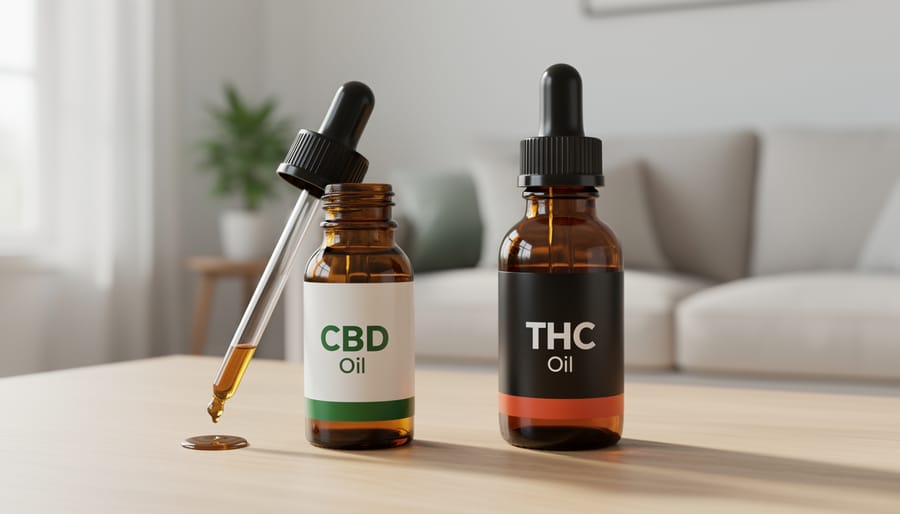
CBD: The Non-Intoxicating Cannabinoid
CBD, short for cannabidiol, is one of over 100 cannabinoids found in cannabis plants. Unlike THC, it doesn’t produce a high, you won’t feel intoxicated, foggy, or impaired. This is why CBD won’t get you high even when you take substantial amounts.
Extracted from hemp or cannabis plants through methods like CO2 extraction or ethanol extraction, CBD is available in countless forms: oils, capsules, gummies, topicals, and vape liquids. Each delivery method affects how quickly and how much CBD enters your system, with vaping offering the fastest onset.
CBD’s popularity for wellness purposes, including anxiety management, has exploded over the past several years. Walk into any health store and you’ll see shelves lined with CBD products making subtle promises about calm and balance. This popularity stems partly from CBD’s non-intoxicating profile, people want relief without getting high, and partly from aggressive marketing that often outpaces the actual evidence. While observational research from Canadian medical cannabis clinics has suggested CBD-rich treatments might benefit anxiety symptoms, the clinical picture remains incomplete, something we’ll explore in depth later.
THC: The Psychoactive Compound
THC, delta-9-tetrahydrocannabinol, is the cannabinoid that produces cannabis’s signature high. When you vape or consume THC, it binds strongly to CB1 receptors concentrated in your brain, triggering the euphoria, altered perception, and relaxation people associate with being stoned. This is fundamentally different from CBD, which doesn’t create intoxication.
That psychoactive effect is both THC’s appeal and its complication for anxiety. Some users report that THC helps them unwind and quiets racing thoughts, particularly at lower doses or in strains balanced with CBD. The problem? THC can just as easily spike anxiety, especially at higher doses or in people sensitive to its effects. I’ve experienced both sides, a small amount might take the edge off, but too much triggers the exact jittery discomfort I was trying to escape.
Despite anecdotal support, clinical research hasn’t established THC as an effective anxiety treatment. The evidence remains insufficient, and THC’s unpredictable impact on anxiety symptoms makes it a riskier experiment than CBD. Yet some still advocate for it, believing the entourage effect of whole-plant cannabis offers benefits isolated cannabinoids can’t match. That’s speculation rather than proven science, though.
CBD vs. THC for Anxiety: What the Research Actually Shows
The Clinical Evidence Gap
When major reviews examined cannabinoids for anxiety, they reached conclusions that disappointed many hopeful users. Multiple large-scale analyses found insufficient evidence for CBD and THC in treating anxiety disorders specifically, along with mental disorders more broadly and mood conditions. The Wilson et al. study, one of the most cited, found no significant difference between cannabinoids and placebo for anxiety symptoms. The largest medicinal cannabis review to date concluded it doesn’t effectively treat anxiety, depression, or PTSD.
Here’s what matters: “insufficient evidence” doesn’t mean researchers proved these compounds don’t work. It means the studies conducted so far haven’t met the rigorous standards needed to demonstrate efficacy. Many existing studies were too small, poorly controlled, used inconsistent dosing, or lacked proper comparison groups. The bar for proving a treatment works is intentionally high, requiring multiple well-designed trials showing consistent results.
Think of it this way, if I told you I vape CBD for anxiety and it helps, that’s one person’s experience. Clinical medicine needs dozens of studies with hundreds of participants, controlled conditions, and reproducible outcomes. The current research simply hasn’t reached that threshold yet. It’s not a closed case against cannabinoids; it’s an open question waiting for better evidence. That distinction shapes how you should approach these options.
Observational Data and Real-World Use
While the large clinical trials showed limited evidence, observational research from real-world cannabis clinics tells a somewhat different story. A retrospective study from Canadian clinic CBD-rich benefits found that patients using CBD-dominant cannabis products reported meaningful reductions in anxiety symptoms over time. Similar patterns appeared in patient registries from other medical cannabis programs, where people tracked their own symptom changes.
Here’s the critical distinction: observational studies track what happens when people use cannabis in everyday life, but they can’t prove causation the way controlled trials do. Maybe the CBD helped. Maybe people felt better because they expected to, or because their circumstances improved, or because they were simultaneously trying other strategies. We simply can’t isolate the CBD’s role without a control group.
I’ve noticed this tension in conversations with readers who swear CBD changed their anxiety management. Their experiences are real and valid, but they don’t constitute clinical proof. This is especially important when considering whether does CBD cancel THC effects in combination products, where multiple variables make causation even harder to determine.
How They Work Differently in Your Body
CBD’s Subtle Influence
CBD’s effects are notoriously understated compared to THC’s obvious high. When I first tried CBD vape products, I kept waiting for something dramatic to happen, some clear shift in mood or sensation. It never came. What users typically report, myself included, is more of an absence than a presence: you might notice you’re not as tense as you were an hour ago, or that anxious thoughts have quieted slightly without any “taking effect” moment you can pinpoint.
Vaping CBD delivers the fastest onset of any consumption method, usually within five to fifteen minutes as the cannabinoid enters your bloodstream through lung tissue. Oils taken under the tongue might take thirty to sixty minutes, while edibles can require an hour or two. This speed makes vaping useful for situational anxiety, though the effects typically fade within two to three hours compared to longer-lasting oral methods.
For anxiety-specific use, anecdotal reports vary widely. Some people describe a gentle calming effect or reduced physical tension. Others feel nothing distinguishable from placebo. The observational research from Canadian medical cannabis clinics suggested potential benefits from CBD-rich treatments, but your individual response will likely require personal experimentation to determine whether CBD produces meaningful anxiety relief for you.
THC’s Double-Edged Nature for Anxiety
THC’s relationship with anxiety is genuinely paradoxical. At lower doses, say, a couple of gentle pulls from a balanced vape, it can create a relaxed headspace that temporarily eases worry. But push the dose too high or catch yourself on a stressful day, and that same compound can spiral into racing thoughts and acute discomfort.
This isn’t just individual variation. THC activates CB1 receptors heavily concentrated in areas regulating fear and stress response. When you overwhelm those receptors, the calming effect flips. I’ve experienced this firsthand: a third hit that seemed fine one evening triggered obvious anxiety another time when I was already wound up from work.
Individual sensitivity matters enormously. Some people tolerate THC beautifully for relaxation; others feel paranoid at any dose. Your brain chemistry, tolerance level, surrounding environment, and even your mood before vaping all influence whether THC soothes or amplifies anxiety in that moment.
If you’re exploring THC for anxiety management, start absurdly low, lower than feels necessary, and pay attention to context. Understanding the fundamental differences between Delta 9 vs CBD helps frame realistic expectations about psychoactive effects. And if THC consistently makes anxiety worse rather than better, that’s valuable information worth respecting.
Regulatory Status and What It Means for Your Choices
Understanding how CBD and THC are regulated helps you navigate the practical realities of obtaining and using these cannabinoids for anxiety concerns.
In Canada, both CBD and THC fall under the Cannabis Act, which means Health Canada oversees their regulation regardless of source. Health Canada’s Science Advisory Committee on Health Products Containing Cannabis has assessed the evidence regarding safety, efficacy, and quality of cannabis products, including CBD specifically. This regulatory framework treats all cannabis products as controlled substances requiring specific packaging, labelling, and distribution protocols.
The Cannabis Act and its regulations require plain packaging and labelling for all cannabis products before they can be sold, distributed, or exported. These requirements significantly limit the health claims and wellness messaging manufacturers can include on product packaging. You won’t find anxiety-specific guidance or dosing recommendations on legal Canadian cannabis products because the regulations prohibit therapeutic claims on labels.
This creates a practical disconnect. While you can legally purchase CBD and THC products from licensed retailers, the packaging won’t tell you much about using them for anxiety management specifically. The plain packaging requirements were designed to reduce promotional appeal, but they also mean consumers need to research independently rather than relying on product labels for guidance.
For those exploring CBD vaping specifically, learning how to choose better CBD vape oil becomes essential when product labels provide minimal guidance. If you’re new to cannabis products entirely, a comprehensive vaping guide for beginners can help you understand the practical aspects the regulations don’t address.
The regulatory landscape means you’re responsible for educating yourself about appropriate use, which is why evidence-based information matters more than marketing claims you might encounter outside official channels.
Vaping CBD vs. THC: Product Considerations
When you’re choosing vape products for CBD or THC, the delivery method matters as much as the cannabinoid itself. I’ve tested dozens of cartridges and disposables over the years, and the difference between a quality product and a sketchy one becomes obvious fast, both in how it feels and how safe it is.
Product types you’ll encounter: For CBD, you’ll find dedicated CBD vape cartridges, disposables, and refillable pod systems, often derived from hemp. THC vaping options are similar in format but require purchase through licensed cannabis retailers in Canada. Some products contain both cannabinoids in various ratios, which can moderate THC’s intensity but complicates dosing if you’re trying to isolate effects.
Quality markers I always check: The vape market has matured considerably, but quality still varies wildly. Look for third-party lab testing results showing cannabinoid content and confirming the absence of heavy metals, pesticides, and cutting agents like vitamin E acetate (which caused serious lung injuries in 2019-2020). In Canada, licensed products must meet Health Canada’s packaging and labelling requirements under the Cannabis Act, which mandates plain packaging and standardized information, this regulatory framework offers baseline safety assurances that unregulated products lack.
When selecting products, consider these factors:
- Lab-verified cannabinoid content matching label claims
- Full ingredient disclosure, particularly regarding carrier oils and thinning agents
- Hardware quality, ceramic coils generally produce cleaner vapour than older wick-based designs
- Reputable manufacturer with transparent sourcing practices
- Proper packaging with batch numbers and production dates
- Clear dosing information per inhalation or cartridge volume
Dosing differences: CBD vaping typically requires higher doses than THC to notice effects, I’ve found 10-25mg CBD per session feels like a reasonable starting range, while 2-5mg THC can produce noticeable psychoactive effects. Start low regardless, since vaping delivers cannabinoids rapidly and you can always take another puff in ten minutes.
If you’re specifically interested in CBD options, our guide to CBD strains for anxiety covers product-specific considerations in detail. The key is recognizing that vaping offers quick onset but also requires more frequent dosing compared to edibles, useful for situational anxiety but potentially inconvenient for all-day management.
Who Should Consider CBD vs. THC for Anxiety
CBD May Be Worth Exploring If…
CBD might be worth considering as a personal experiment if you want to avoid intoxication entirely. Its non-psychoactive profile means you can go about your day without impairment, which matters if you work, drive, or just prefer staying clear-headed. I’ve vaped CBD products during work hours without any cognitive fog, something I’d never attempt with THC.
You might also lean toward CBD if you’re in a jurisdiction where THC remains legally problematic or if your workplace conducts drug testing. CBD derived from hemp typically contains negligible THC, reducing legal and employment concerns.
The observational research from Canadian medical cannabis clinics showing potential anxiety symptom benefits with CBD-rich treatments provides some real-world support, even though we’re still missing rigorous clinical trial evidence. If you’re comfortable with that evidence gap and willing to approach CBD as an exploratory wellness tool rather than proven medicine, it’s reasonable to try.
Start conservatively, perhaps a low-dose vape session in a comfortable setting where you can gauge your response. Track how you feel over several sessions before adjusting dose or frequency. And crucially, discuss it with your healthcare provider first, especially if you’re taking other medications or managing diagnosed anxiety disorders. CBD isn’t a replacement for evidence-based treatments, but some people do report it helps them feel calmer.
THC Comes with More Considerations
THC’s relationship with anxiety is paradoxical in a way that makes it risky for anxiety management. While some people report feeling calmer after using THC, others experience heightened anxiety, racing thoughts, or full-blown panic attacks, even from the same dose that helped them before. This unpredictability stems from THC’s psychoactive nature and how it can amplify whatever mental state you’re already in.
I’ve seen this firsthand: a friend who occasionally used THC for stress found that during an already anxious week, even a small amount triggered intense paranoia. The very intoxication that some find relaxing can feel destabilizing when you’re already on edge. Research backs this concern, the major reviews finding insufficient evidence for cannabinoids in treating mental disorders specifically note THC’s potential to worsen anxiety symptoms in vulnerable individuals.
That said, some people do find carefully controlled, low doses helpful, particularly when combined with CBD. If you’re considering THC despite these risks, start with minimal amounts, avoid it during acute anxiety episodes, and have a trusted person nearby the first few times. Never use it as a substitute for professional anxiety treatment, and be honest with your healthcare provider about any cannabis use, they need the full picture to help you effectively.
What Each Option Is
CBD and THC are both cannabinoids, naturally occurring compounds found in cannabis plants, but they interact with your body in fundamentally different ways.
CBD, short for cannabidiol, is the non-intoxicating option. It won’t get you high, which is why it’s become widely available in everything from oils to vape liquids. People use it for various wellness purposes, including anxiety management, though clinical evidence remains limited. When I first tried CBD vaping, I was struck by how subtle the experience was, no altered state, just a gentle sense of calm that might have been placebo for all I knew at the time.
THC, or tetrahydrocannabinol, is the psychoactive compound responsible for marijuana’s characteristic high. It alters perception, mood, and cognition in ways that range from relaxing to anxiety-inducing, depending on the person and dose. Some users swear by low-dose THC for anxiety relief, while others find it makes anxiety worse, a variability that matters enormously if you’re considering it.
Both compounds interact with your endocannabinoid system, but through different pathways that produce distinctly different experiences. Understanding these differences is essential before deciding which, if either, aligns with your anxiety management goals.
Dimension-by-Dimension Comparison
When I’m comparing CBD and THC for anxiety, I look at six dimensions that actually matter in real-world use.
Psychoactive effects: THC gets you high; CBD doesn’t. That’s the fundamental split. THC’s intoxication can feel relaxing to some people but anxious or paranoid to others. CBD works in the background without altering your headspace.
Clinical evidence: Here’s where both disappoint. Major reviews, including Wilson et al., found insufficient evidence for either cannabinoid in treating anxiety disorders. Neither has the research backing you’d want for a legitimate anxiety treatment, though observational research from Canadian medical cannabis clinics suggested some CBD-rich treatments might help anxiety symptoms.
Onset and duration: When vaped, both hit quickly, within minutes. THC’s effects peak faster and feel more pronounced. CBD’s subtle influence takes longer to notice, if you notice it at all.
Legal and workplace concerns: CBD is broadly legal and won’t show up problematically on drug tests. THC remains restricted and will flag standard screenings.
Dosing precision: CBD allows easier experimentation since there’s no high to overshoot. THC demands more caution, too much reliably triggers anxiety rather than relieving it.
Side effect profile: CBD’s side effects are minimal. THC carries real risks of worsening anxiety, especially at higher doses.
Who Should Choose Which
Consider CBD if you:
– Want to explore cannabinoids without intoxication, CBD won’t get you high, which matters if you drive, work, or simply dislike altered mental states
– Prefer starting with the option backed by observational research showing potential anxiety benefits from CBD-rich treatments
– Live where THC remains restricted or workplace testing makes it a non-starter
– Have past negative experiences with THC triggering anxiety or paranoia
– Need something you can use throughout the day without impairing function
Consider THC (cautiously) if you:
– Already tolerate THC well and find lower doses help you relax without worsening anxiety
– Have access through legal medical cannabis programs and professional guidance
– Can manage the intoxication and aren’t sensitive to THC’s anxiety-provoking potential
– Accept the higher regulatory and practical barriers (legal status, workplace policies, driving restrictions)
Skip both if you:
– Expect clinically-proven anxiety treatment, neither cannabinoid meets that standard based on current evidence
– Have a history of THC-induced panic or severe anxiety reactions
Always consult your healthcare provider before trying either cannabinoid for anxiety management, especially if you take prescription medications or have underlying health conditions.
Common Questions About CBD vs. THC for Anxiety
Which is more effective for anxiety: CBD or THC?
Current research doesn’t demonstrate that either CBD or THC effectively treats anxiety disorders. Major reviews have found insufficient evidence for both cannabinoids, with one large study showing no significant difference between cannabinoids and placebo for anxiety symptoms. While some users report benefits, particularly with CBD-rich products based on observational data from medical cannabis clinics, these subjective experiences don’t constitute clinical proof of efficacy.
Does combining CBD and THC work better for anxiety?
There’s no strong clinical evidence supporting that combining CBD and THC provides superior anxiety relief compared to either alone. Some users believe CBD can moderate THC’s psychoactive effects, which might reduce anxiety triggered by high THC doses, but this hasn’t been definitively proven in controlled research for anxiety specifically.
How quickly do CBD and THC work when vaped?
When vaped, both CBD and THC enter your bloodstream rapidly, typically within minutes. You’ll feel THC’s psychoactive effects almost immediately, usually peaking around 10-15 minutes after inhaling. CBD’s effects are subtler and harder to pinpoint, though any perceived impact generally begins within the same timeframe. Onset speed varies based on your metabolism, the product strength, and how deeply you inhale.
Can CBD or THC replace prescribed anxiety medications?
No. Neither CBD nor THC should replace prescribed anxiety medications without your doctor’s explicit guidance. Clinical evidence supporting cannabinoids for anxiety treatment remains insufficient, while many prescription medications have decades of research backing their efficacy. If you’re considering cannabinoids alongside prescribed treatments, discuss it with your healthcare provider first, some interactions can occur.
Is it safe to use CBD or THC for anxiety?
Safety depends on multiple factors including product quality, dosing, your health status, and other medications you take. CBD generally has a favorable safety profile with mild potential side effects like fatigue or appetite changes. THC carries more concerns, including potential to worsen anxiety in some people, impairment while intoxicated, and possible long-term effects with heavy use. Both should be sourced from regulated suppliers, and you should consult a healthcare professional before trying either, especially if you have existing health conditions or take medications.
Why do some people swear by CBD for anxiety if the evidence is lacking?
Personal experiences vary widely, and several factors might explain why some users report benefits despite insufficient clinical evidence. Placebo effects are real and can provide genuine symptom relief. Observational research from Canadian medical cannabis clinics has suggested CBD-rich treatments may help some individuals, though these studies lack the rigorous controls of clinical trials. It’s also possible that CBD works for a subset of people in ways current research hasn’t fully captured yet.
These questions reflect what I hear most often from people weighing CBD versus THC for anxiety. The honest answer to nearly all of them circles back to the same frustrating reality: we don’t have the clinical data to make definitive claims, even though plenty of individuals report subjective benefits.
I’ve watched friends and readers navigate this uncertainty firsthand. Some try CBD and feel noticeably calmer within days. Others notice nothing at all. A few experiment with low-dose THC and find it helps them unwind, while others experience the opposite, racing thoughts and heightened nervousness. The wide range of responses underscores why anecdotal experiences, however compelling, can’t substitute for rigorous research.
What’s clear is that neither cannabinoid is a proven replacement for established anxiety treatments, and anyone considering them should approach with realistic expectations. If you do decide to experiment, start conservatively, pay attention to how you actually feel rather than how you expect to feel, and keep your healthcare provider in the loop. The gap between marketing promises and clinical evidence remains substantial, but that doesn’t mean these compounds have zero potential, just that we need much more research before making confident recommendations.
The gap between clinical research and marketing hype around CBD and THC for anxiety remains wide. Multiple large-scale reviews have found insufficient evidence to recommend either cannabinoid for treating anxiety disorders, and the largest review to date found cannabinoids ineffective for anxiety, depression, and PTSD. That’s the scientific reality we need to start from.
Yet observational research from Canadian medical cannabis clinics suggests some people using CBD-rich treatments report improvements in anxiety symptoms. These aren’t controlled trials, but they represent real-world experiences that shouldn’t be dismissed entirely.
If you’re considering trying CBD or THC for anxiety, consult your healthcare provider first. Don’t discontinue prescribed medications without medical guidance. Start conservatively with CBD-only products if you want to avoid psychoactive effects, and keep your expectations realistic. You’re experimenting with something that lacks robust clinical validation, not accessing a proven treatment.
I’ve shared what I know from both research and personal experience with these cannabinoids. Your mileage will vary. What works for someone else might not work for you, and that’s completely normal given how little we understand about individual responses to cannabinoids.
Keep learning, stay skeptical of bold marketing claims, and share your experiences with your healthcare team.